Commercial construction companies in Los Angeles operate within one of the world’s most complex and dynamic building environments. The city spans 503 square miles across diverse terrain, from coastal districts to inland valleys and hillside communities, serving nearly 4 million residents as the commercial center of Southern California.
Los Angeles commercial construction encompasses office towers in downtown’s Financial District, retail developments along major corridors, hospitality projects in entertainment zones, industrial facilities in the Ports area, and mixed-use developments transforming neighborhoods citywide. Major projects navigate layered regulations, seismic requirements, challenging logistics, and coordination demands that separate the wheat from the chaff.
WakeCo brings comprehensive general contracting and construction management capabilities to major commercial projects throughout Los Angeles and Southern California. Our experience across diverse sectors, project scales, and delivery methods positions us to handle the technical, logistical, and coordination challenges that define successful large-scale construction in this demanding market.
What Defines Major Commercial Projects
Major commercial construction projects carry complexity, scale, and risk beyond typical builds. These projects demand specialized capabilities, substantial resources, and proven systems that ensure successful delivery despite significant challenges.
Scale and Complexity Thresholds
Major projects typically involve budgets exceeding several million dollars, timelines spanning months or years, and coordination of dozens of subcontractors and suppliers. Building systems integrate mechanical, electrical, plumbing, fire protection, life safety, and technology infrastructure requiring precise coordination.
Multi-story construction introduces structural complexity, vertical material logistics, and phased sequencing that differs fundamentally from single-story work. Site logistics in urban Los Angeles environments require creative solutions for material staging, equipment access, worker parking, and neighbor coordination.
Tight sites demand vertical material lifts, night work for noise-sensitive activities, and traffic management plans satisfying city requirements. These operational complexities require experienced management and robust planning systems.
Regulatory Navigation and Risk Management
Los Angeles Department of Building and Safety enforces California Building Code with city-specific amendments addressing seismic design, energy performance, accessibility, and life safety. Major projects undergo plan check by multiple city departments plus outside agencies for specialized systems.
Environmental review under CEQA applies to many significant projects, requiring impact analysis and mitigation measures. Historic preservation review affects projects in designated districts. Fire department review becomes intensive for high-rises and complex buildings. Coordinating these overlapping jurisdictions requires experience and established relationships.
Major projects carry substantial financial risk. Performance and payment bonds protect owners and subcontractors, but obtaining bonding requires proven financial stability and successful project history. Insurance requirements escalate with project size. Top commercial contractors maintain bonding relationships and insurance programs supporting projects of significant scale.
Los Angeles Commercial Sectors and Project Types
Commercial construction in Los Angeles spans diverse sectors, each with specialized requirements and market dynamics. Top firms bring expertise across multiple sectors rather than narrow specialization.
Office and Corporate Facilities
Office construction serves industries from entertainment and technology to finance and professional services. Class A office buildings demand high-performance building envelopes, sophisticated HVAC systems, advanced life safety features, and technology infrastructure supporting modern workplace requirements.
Tenant improvement work customizes shell spaces to specific occupant needs with private offices, open work areas, conference facilities, and amenity spaces. Adaptive reuse converts historic or obsolete buildings into modern office space, balancing preservation requirements with contemporary performance standards.
Retail and Mixed-Use Developments
Retail construction includes street-front stores, shopping centers, entertainment venues, and mixed-use developments combining retail with residential or office uses. Los Angeles retail corridors demand designs respecting neighborhood character while meeting operational needs.
Mixed-use projects coordinate multiple occupancy types with distinct requirements. Residential units above ground-floor retail require sound isolation, separate building systems, varied accessibility standards, and coordination of different building codes applying to each use.
Restaurant and entertainment venue construction involves complex kitchen systems, specialized ventilation, acoustic design, and finishes creating desired atmosphere. High-profile projects often involve design teams creating signature environments supporting brand identity.
Industrial and Logistics Facilities
The Ports of Los Angeles and Long Beach drive significant industrial construction including warehouses, distribution centers, and manufacturing plants. These projects emphasize operational efficiency, clear heights, loading dock configurations, and heavy-duty structural systems.
Last-mile distribution facilities support e-commerce logistics throughout the Los Angeles basin. Specialized industrial construction serves entertainment production, aerospace, food processing, and other sectors with unique requirements including soundstages, clean rooms, and refrigerated spaces.
Hospitality and Entertainment
Hotel construction serves the tourism, business travel, and entertainment sectors. Projects range from boutique hotels in trendy neighborhoods to large convention hotels downtown. Hospitality construction coordinates guestrooms, public spaces, food and beverage facilities, back-of-house operations, and meeting spaces.
Entertainment venues including theaters, concert halls, and event spaces demand specialized acoustic design, rigging systems, lighting and sound infrastructure, and crowd management considerations. These projects often become architectural landmarks contributing to Los Angeles’s cultural landscape.
What Top Firms Bring to Major Projects
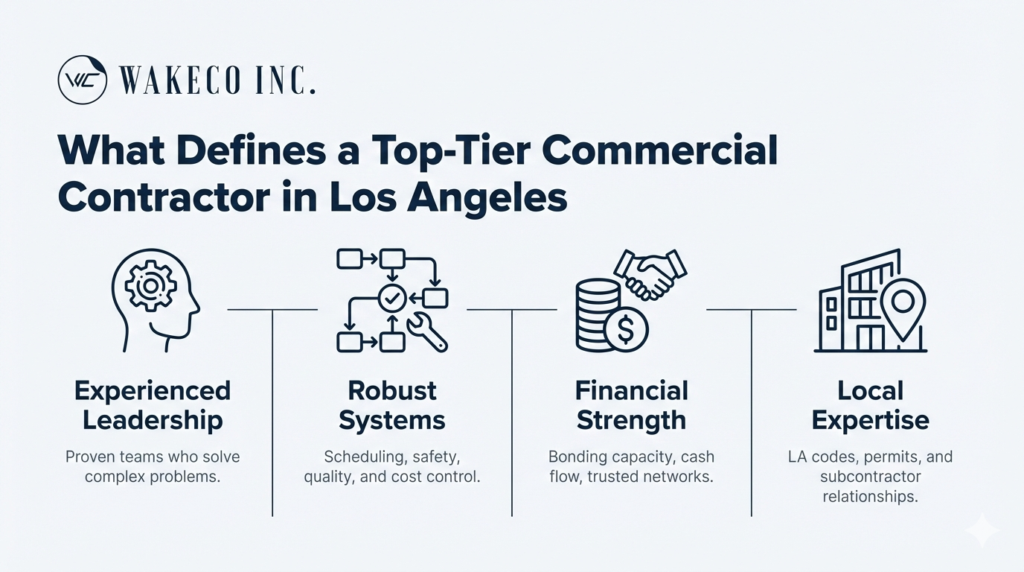
Successful major commercial construction requires capabilities, resources, and systems beyond what smaller or less experienced firms can provide. Top firms demonstrate consistent excellence across multiple dimensions.
Experienced Leadership and Management
Project executives and managers on major work bring years of experience navigating complex construction challenges. They’ve managed multiple large projects, understand what problems arise, and maintain composure when issues emerge.
Superintendent experience matters enormously. Running jobsites with hundreds of workers, coordinating dozens of subcontractors, and managing logistics in constrained urban sites all require seasoned field leadership. Top firms assign proven superintendents to significant projects.
Estimating and preconstruction teams must accurately price complex work, identify cost drivers, and provide value engineering that maintains project intent while controlling budgets. Sophisticated estimating systems and relationships with reliable subcontractors support accurate pricing.
Robust Systems and Processes
Major projects require documented systems for scheduling, cost control, quality management, safety, and document control. Project scheduling uses critical path methodology identifying task dependencies and milestone sequencing. Cost control systems track committed costs, pending changes, and projected final costs.
Quality control plans define inspection points and testing requirements. Safety programs establish protocols, provide training, conduct regular audits, and investigate incidents to prevent recurrence. These systems separate capable firms from those operating reactively.
Financial Strength and Networks
Major projects require substantial upfront investment in mobilization, equipment, and materials before owner payments arrive. Financial strength allows contractors to fund these costs without cash flow problems that delay work.
Bonding capacity reflects underwriter confidence in contractor capability and financial stability. Banking relationships provide operating lines of credit supporting working capital needs across multiple active projects.
Subcontractor and supplier networks provide access to reliable trades and materials. Top general contractors maintain extensive networks of qualified subs proven through prior successful collaboration.
The WakeCo Approach to Major Commercial Projects
Our capabilities and experience position us to successfully deliver significant commercial construction throughout Los Angeles and Southern California. We bring the resources, systems, and expertise major projects demand.
Comprehensive Preconstruction Services
Major projects benefit enormously from thorough preconstruction planning. We provide detailed cost estimating, constructability review, value engineering, schedule development, and permit coordination during design phases.
Early contractor involvement identifies potential issues when solutions remain cost-effective. Budget tracking throughout design prevents surprises. Owners see cost implications of design decisions in real-time, supporting informed choices about scope and investment.
Proven Project Management
Our project management approach emphasizes proactive planning, clear communication, and systematic problem-solving. Weekly coordination meetings keep all parties aligned. Schedule updates track progress against milestones. Cost reports provide transparent budget visibility.
We maintain organized jobsites with clear safety protocols, efficient material flow, and coordination supporting productive work. Quality control happens throughout construction through inspections at logical milestones, producing buildings that perform as designed.
Sector Experience and Local Knowledge
Our portfolio includes office buildings, retail developments, industrial facilities, hospitality projects, and mixed-use construction throughout Southern California. We understand Los Angeles permitting processes, building codes, and inspection expectations.
Established relationships with city departments, utility providers, and specialty consultants support efficient approval processes. Our subcontractor networks include the reliable, capable trades required for major work, supporting competitive pricing and quality execution.
Delivering Excellence on Major Projects
Commercial construction companies in Los Angeles handling major projects must demonstrate financial strength, proven experience, robust systems, and comprehensive capabilities. Success requires management excellence, risk mitigation, and ability to coordinate complex efforts toward unified goals.
Major commercial projects represent significant investments deserving experienced, capable partners who deliver on commitments. The difference between top firms and others shows in performance under pressure, problem-solving when challenges arise, and ultimate project outcomes.
Ready to discuss your major commercial project? Contact WakeCo for a comprehensive consultation. We’ll review your vision, discuss our approach, and explain how our capabilities support successful delivery. Let’s build something significant together—call now or request a project discussion online. Major projects demand major capabilities and proven performance.
Frequently Asked Questions
What qualifies as a “major” commercial construction project?
Major projects typically involve budgets exceeding several million dollars, multi-story or complex construction, extended timelines, sophisticated building systems, and substantial coordination requirements. These projects require bonding, robust management systems, experienced leadership, and proven contractor capabilities beyond what smaller firms provide.
How do top commercial contractors differ from smaller firms?
Top firms bring greater financial strength, higher bonding capacity, more experienced management, documented systems for quality and safety, established subcontractor networks, and proven track records on similar projects. They maintain resources supporting multiple simultaneous projects and absorb challenges that would overwhelm smaller operations.
What delivery methods work best for major commercial projects?
Design-bid-build, design-build, construction management at-risk, and integrated project delivery all have appropriate applications depending on project characteristics and owner priorities. Each method offers different advantages regarding cost control, schedule compression, and risk allocation. Experienced contractors work effectively across multiple delivery methods.
How long do major commercial projects typically take in Los Angeles?
Office buildings might require 18-36 months from design through completion. Retail developments often finish in 12-24 months. Industrial facilities may complete in 9-18 months. Permitting adds months before construction begins. Complex projects in constrained urban sites generally require longer than suburban developments.
Why choose WakeCo for major commercial construction?
We bring comprehensive capabilities including proven project management, financial strength supporting bonding requirements, experienced leadership, documented quality and safety systems, and extensive Southern California experience including Los Angeles’s complex regulatory environment. Our portfolio demonstrates successful delivery of significant commercial projects across diverse sectors.