A general contractor in Costa Mesa operates within one of Orange County’s most dynamic urban centers. With approximately 113,000 residents across 16 square miles, Costa Mesa balances residential neighborhoods, commercial districts, cultural institutions, and one of Southern California’s most significant retail corridors along South Coast Plaza and the Bristol Street area.
The city’s flat topography, proximity to John Wayne Airport, and position between the Pacific Coast and inland Orange County create unique construction opportunities. Projects range from mid-century home renovations in established neighborhoods to commercial tenant improvements in mixed-use developments and adaptive reuse projects in the evolving industrial zones.
WakeCo approaches Costa Mesa construction through integrated design-build services that streamline project delivery. By coordinating design and construction under unified management, we reduce timelines, control costs, and ensure buildability from initial concepts through final completion. Our work reflects understanding of Costa Mesa’s urban character and commitment to projects that function beautifully while meeting practical needs.
Understanding Design-Build: A Better Way to Deliver Projects
Traditional design-bid-build processes separate design and construction into sequential phases managed by different parties. Architects complete designs, contractors bid on finished plans, and construction begins. This fragmentation creates communication gaps, delays, and potential conflicts when drawings don’t align with buildability or budget realities.
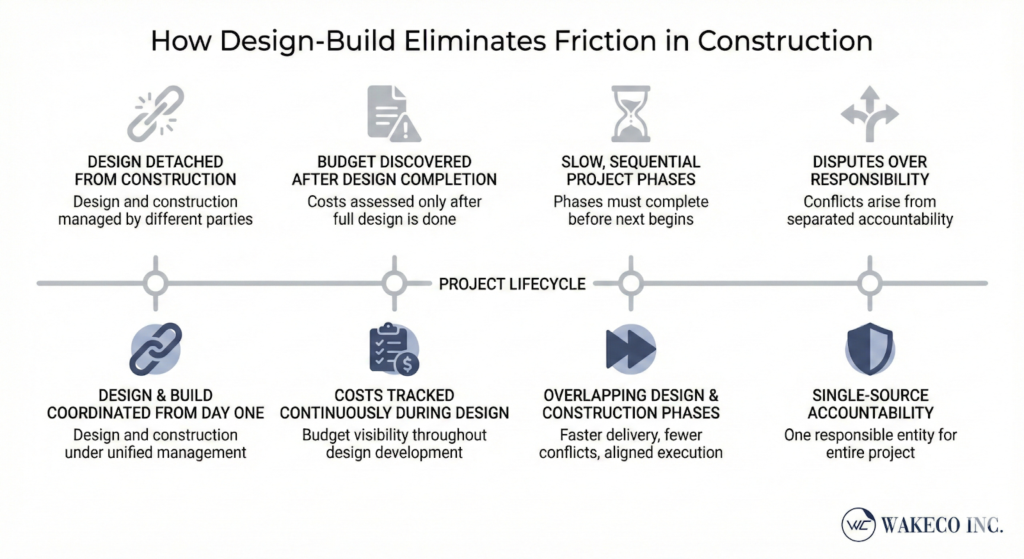
Design-build integrates these functions under single-source responsibility. One team manages both design development and construction execution, creating alignment from project inception through completion.
How Design-Build Works
Design-build projects begin with client goals, budget parameters, and site conditions. The design-build team develops concepts that balance aesthetic vision with constructability and cost control. Early involvement of construction expertise prevents designs that look attractive on paper but create field problems or budget overruns.
Preconstruction services include schematic design, preliminary budgeting, site analysis, and feasibility assessment. Clients see costs throughout design development rather than discovering budget gaps after design completion. Value engineering happens continuously, identifying cost-effective alternatives without compromising essential goals.
Construction proceeds with the same team that developed designs. Questions get answered immediately because designers and builders work together daily. Changes integrate smoothly because decision-makers understand both design intent and construction implications. This continuity eliminates finger-pointing between separate design and construction contracts.
Advantages Over Traditional Delivery
Single-source accountability means one entity takes responsibility for performance, schedule, and budget. No disputes about whether problems stem from design errors or construction defects—the design-build team owns complete project delivery.
Compressed timelines result from overlapping design and construction phases. Long-lead materials can be ordered while details finalize. Site work may begin during permit review. Fast-track scheduling reduces overall project duration compared to sequential design-then-build approaches.
Cost certainty develops early. Continuous budget tracking throughout design prevents unwelcome surprises. Value engineering identifies savings without quality compromise. Transparent pricing shows where money goes and how design decisions affect costs.
Enhanced collaboration produces better outcomes. Designers benefit from construction expertise during conceptual phases. Builders understand design intent rather than interpreting finished drawings. Clients engage with one integrated team instead of coordinating between separate contracts.
Design-Build Applications Across Project Types
Design-build methodology adapts effectively across diverse construction scenarios, from custom homes to complex commercial developments. Integration of design and construction creates value regardless of project scale or type.
Custom Homes and Major Renovations
Custom home design-build starts with lifestyle discussions—how clients live, entertain, work from home, and use outdoor spaces. Design responds to these patterns while addressing site opportunities and constraints.
Budget transparency throughout design prevents scope creep. Clients see cost implications of every decision—higher ceilings, premium finishes, complex rooflines, or upgraded systems. This visibility supports informed choices that align vision with financial reality.
Construction expertise informs design decisions. Structural systems, mechanical layouts, and construction sequencing all influence design development. Early coordination prevents expensive field changes when drawings meet reality.
Major renovations benefit particularly from design-build integration. Existing conditions revealed during demolition often require design adjustments. Having designers and builders on the same team allows immediate response rather than change order negotiations between separate contracts.
Commercial Tenant Improvements
Commercial tenants need spaces delivered quickly to minimize lost business time. Design-build compresses timelines through fast-track scheduling and concurrent design-construction phases.
Tenant input shapes design direction. Restaurant owners describe service flow and kitchen requirements. Retailers explain merchandise display needs and customer circulation patterns. Office tenants specify collaboration areas, private spaces, and technology infrastructure. Design-build teams incorporate this operational knowledge into functional layouts.
Value engineering identifies cost savings without compromising essential functions. Alternative materials, efficient layouts, and smart system selections deliver required performance within budget constraints.
Restaurants and Specialized Facilities
Restaurant design-build requires specialized expertise. Dining atmosphere, kitchen efficiency, health department compliance, and operational workflow all demand careful coordination.
Concept development explores brand identity, target demographics, and competitive positioning. Design expresses these intangibles through space planning, material selections, lighting design, and architectural details that create desired ambiance.
Kitchen design coordinates equipment specifications, ventilation requirements, plumbing and electrical demands, food storage, and service flow. Health department requirements influence layouts, finishes, and systems. Early coordination prevents expensive revisions during permit review.
Medical offices and specialized clinical facilities carry unique requirements. Design-build teams include experience with medical codes, health department requirements, and operational workflows. HIPAA compliance influences space planning and acoustic design, while infection control considerations affect material selections and HVAC filtration.
The WakeCo Design-Build Process
Our integrated approach coordinates design vision with construction reality, creating alignment that delivers superior outcomes on schedule and within budget.
Discovery and Conceptual Design
Projects begin with thorough discussion of goals, priorities, budget parameters, and timeline requirements. We explore how spaces will be used, what aesthetic direction resonates, and what constraints exist.
Site analysis examines existing conditions, access, utilities, drainage, views, solar orientation, and regulatory requirements. This information shapes design opportunities and constraints.
Conceptual design develops spatial relationships, circulation patterns, and architectural character. Early budgeting ensures concepts align with financial reality. Clients see both design direction and associated costs, enabling informed decisions about scope and investment.
Design Development and Preconstruction
Selected concepts advance through detailed design. Floor plans refine room sizes and relationships. Elevations establish exterior character and materials. Systems planning coordinates mechanical, electrical, plumbing, and structural requirements.
Budget tracking continues throughout development. Material selections, system specifications, and detail complexity all influence costs. Transparent tracking prevents budget surprises and supports value engineering when needed.
Permit documentation assembles drawings, calculations, and specifications required for approval. Our familiarity with Costa Mesa’s Development Services processes streamlines submissions and reduces correction cycles.
Final budgets incorporate complete scope with detailed cost breakdowns. Schedules identify construction sequencing, long-lead procurement, inspection milestones, and substantial completion targets.
Construction and Completion
Active construction brings integrated design-build advantages into focus. Daily coordination keeps work progressing efficiently. Questions receive immediate answers from designers familiar with project intent. Field conditions requiring adjustments get resolved through collaborative problem-solving.
Quality control verifies work meets design specifications and code requirements. Regular inspections catch issues early when corrections are simple. Client communication provides progress visibility and addresses decisions requiring input.
Completion includes thorough inspections, punch list resolution, system demonstrations, and documentation delivery. We provide operation and maintenance information, warranty details, and closeout documents. Post-occupancy support addresses any items requiring attention through warranty periods and ongoing client relationships.
Building Costa Mesa’s Future
A general contractor in Costa Mesa using design-build methodology delivers projects through integrated planning and execution. Single-source accountability, compressed timelines, cost certainty, and enhanced collaboration create superior outcomes compared to fragmented traditional delivery.
Whether planning a custom home, commercial tenant improvement, restaurant development, or specialized facility, design-build offers advantages worth considering. Integration of design and construction under unified management reduces risk, accelerates delivery, and produces results that work.
Ready to explore design-build for your project? Contact WakeCo for a comprehensive consultation. We’ll discuss your vision, assess site opportunities, and explain how integrated design-build delivery can benefit your specific needs. Let’s create something exceptional together—call now or request a project discussion online. Your vision deserves seamless execution from concept through completion.
Frequently Asked Questions
What’s the main advantage of design-build over traditional methods?
Single-source accountability eliminates finger-pointing between separate design and construction contracts. Design-build teams own complete project delivery—design, budget, schedule, and quality. This integration compresses timelines through overlapping phases, provides cost certainty throughout design, and ensures buildability from initial concepts. Clients manage one relationship instead of coordinating between separate contracts.
Does design-build cost more than traditional delivery?
Design-build typically costs less despite integrated services. Early construction input prevents expensive design changes during construction. Value engineering happens throughout design rather than after completion. Compressed timelines reduce financing costs and allow earlier occupancy. Reduced change orders from better-coordinated documents further control costs.
Can I still have input on design with design-build?
Absolutely. Design-build enhances client involvement rather than limiting it. You work directly with integrated teams who explain trade-offs between design options and costs. This transparency supports informed decisions. Many clients find design-build more collaborative because designers and builders present unified recommendations.
How long do Costa Mesa projects typically take with design-build?
Design-build typically reduces total project duration 20-30% compared to traditional methods. Residential renovations might be completed in 3-5 months versus 5-7 months traditionally. Commercial tenant improvements often deliver in 2-4 months versus 4-6 months. Fast-track scheduling overlaps design and construction phases while maintaining quality.
What experience does WakeCo have with Costa Mesa design-build projects?
Our portfolio includes custom homes, major renovations, commercial tenant improvements, restaurant build-outs, and specialized facilities throughout Costa Mesa. We understand local permitting processes, neighborhood contexts, and urban construction challenges. Our integrated design-build approach has delivered diverse projects on schedule and within budget.