A hospitality contractor in San Diego builds within an industry that generated $12.8 billion in visitor spending during 2023, supporting 194,000 jobs across a region where tourism shapes economic rhythm as much as the Pacific shapes the coastline. The city hosts 35.8 million visitors annually, creating constant demand for hotel renovations, restaurant buildouts, and resort upgrades that must balance operational continuity with construction necessity.
San Diego’s hospitality sector spans downtown convention hotels, beachfront resorts from La Jolla to Coronado, Gaslamp Quarter restaurants, and boutique properties throughout neighborhoods like Little Italy and North Park. Each project operates within constraints where construction schedules compete with revenue calendars and guest experience trumps convenience.
WakeCo delivers hospitality construction throughout San Diego County with expertise spanning hotel renovations, restaurant buildouts, resort facilities, and commercial kitchen installations. Our approach recognizes that hospitality projects serve businesses where downtime equals lost revenue and construction quality directly affects guest perception.
Revenue Protection Through Strategic Phasing
Maintaining Operations During Construction
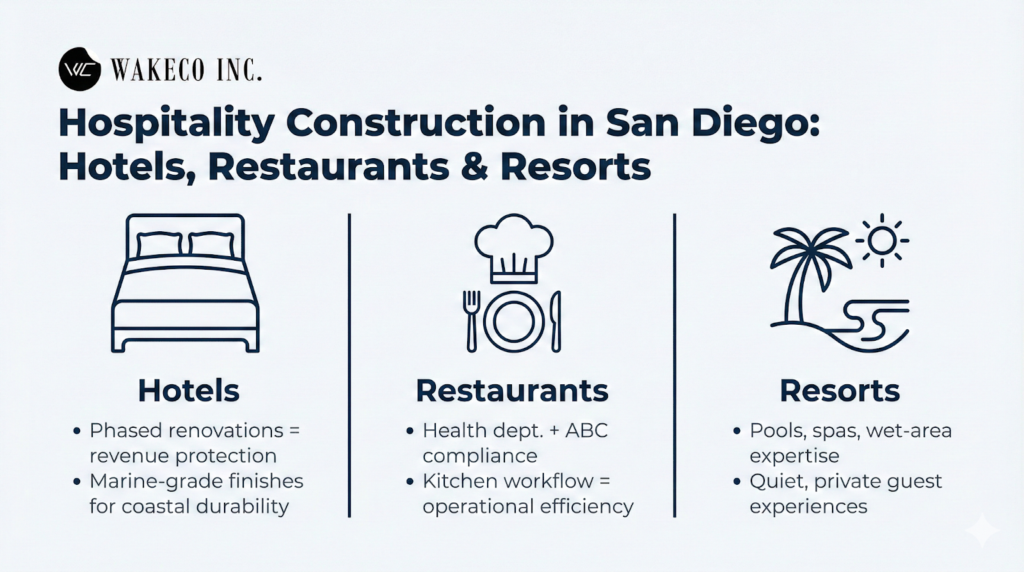
Hotels cannot afford complete closures during renovations. A 200-room property losing $150 per night per room sacrifices $30,000 daily—$900,000 monthly. Phased construction maintains 60-70% occupancy while work proceeds through rolling floor-by-floor renovations.
Restaurant construction faces similar pressures. Closing for three months costs establishments $180,000-$400,000 in lost sales. Strategic phasing allows continued service in dining rooms while back-of-house work progresses, or maintains takeout operations during front-of-house updates.
Timing Around Business Cycles
San Diego’s peak tourism season runs May through September, making fall and winter optimal for major renovations. Comic-Con in July, fleet weeks, and holiday periods influence when properties accommodate construction disruption without devastating revenue.
Construction in occupied hotels requires noise management, dust containment, and circulation planning. Work hours shift to minimize disruption while temporary barriers separate construction zones from public spaces. Dedicated contractor entrances prevent equipment from moving through lobbies.
Hotel Construction Essentials
Guest Room Renovations
Guest room updates—flooring, paint, fixtures, case goods, and soft goods—require 3-5 days per room with experienced crews. Bathroom renovations add complexity through tile replacement, plumbing coordination, and waterproofing requirements. ADA-compliant rooms need specific clearances, grab bar reinforcement, and accessible fixtures meeting current standards.
San Diego’s coastal properties benefit from materials resisting salt air corrosion. Stainless steel hardware, powder-coated fixtures, and marine-grade finishes extend longevity where standard materials deteriorate within 3-5 years. Electrical upgrades support modern expectations—USB charging outlets, adequate lighting, and responsive climate control.
Public Spaces and Lobbies
Lobby renovations affect arrival experience directly. Front desk configurations balance efficiency with hospitality while check-in technology integration requires data cabling and power older properties lack. Material selections withstand heavy foot traffic while conveying market positioning through finish quality.
Lighting design establishes ambiance while providing functional illumination. Layered lighting—ambient, accent, and task—creates flexibility for different times and uses. Seating areas create welcoming spaces without impeding circulation patterns.
Meeting and Event Facilities
Meeting spaces require flexible configurations, substantial HVAC capacity, and technical infrastructure supporting audiovisual systems. Divisible spaces need soundproof partitions operating smoothly while electrical distribution provides adequate power at multiple locations without exposed cords.
Ballroom construction involves large open spans requiring engineered structural systems. Ceiling heights accommodate tall centerpieces and lighting rigs while flooring handles heavy loads from catering equipment and staging. Pre-function spaces need sufficient area for registration tables and attendee circulation.
Restaurant and Commercial Kitchen Construction
Kitchen Layout and Workflow
Kitchen layouts follow workflow principles—receiving flows to storage, storage to prep, prep to cooking, cooking to plating, plating to service. Health departments review layouts ensuring proper separation between raw and cooked foods, adequate hand washing facilities, and appropriate equipment spacing.
Equipment specifications drive utility requirements. Commercial ranges need gas service and Type I exhaust hoods with fire suppression. Walk-in coolers require dedicated electrical circuits and condensate drainage. Dishwashers need hot water supplies, drainage, and chemical dispensing systems meeting California Retail Food Code requirements.
Surface Materials and Safety
Floor drains slope properly for cleaning while wall and ceiling finishes use smooth, non-absorbent materials. Stainless steel panels behind equipment provide durable, cleanable surfaces. Hand washing station placement, three-compartment sink dimensions, and food storage separation all follow strict health department protocols.
Dining Room Design
Dining spaces balance atmosphere with functionality. Acoustic treatments prevent excessive noise—upholstered seating, acoustic ceiling tiles, and textured wall coverings contribute sound absorption. Lighting creates mood while allowing menu reading, using dimmers that provide flexibility for lunch versus dinner service.
Furniture selection considers durability alongside aesthetics. Commercial-grade chairs withstand daily use while tables need stable bases and surfaces resisting spills and heat. Open kitchens add energy but require noise management separating cooking sounds from dining experience.
Bar and Beverage Systems
Bar construction involves complex plumbing—three-compartment sinks for glass washing, separate hand sinks, ice bins with drainage, and beer tap systems requiring glycol cooling lines. Draft beer systems run refrigerated glycol through insulated lines to taps while CO2 distribution pressurizes kegs properly.
Back bar construction showcases bottles while providing storage and workspace. Glass shelving with LED backlighting creates visual appeal while refrigeration occupies under-bar locations. Point-of-sale systems require data connections and secure cash handling areas.
Resort and Wellness Facilities
Pool and Aquatic Construction
Pool construction addresses San Diego’s varying soil conditions from sandy coastal soils to expansive clays inland. Proper excavation, compaction, and structural design prevent settling or cracking. Equipment rooms house pumps, filters, heaters, and chemical systems meeting health department requirements.
Spa and hot tub installations require robust electrical service, gas heating or heat pumps, and circulation systems maintaining water quality. Accessible lifts allow ADA compliance for pool entry while safety covers reduce heat loss and meet code requirements.
Spa Treatment Spaces
Treatment rooms need adequate size for tables, therapist movement, and equipment storage. Lighting uses dimmers creating relaxing environments while HVAC provides quiet, draft-free comfort. Sound control prevents noise transmission between rooms, maintaining privacy and tranquility guests expect.
Wet areas—steam rooms, saunas, hydrotherapy—require specialized construction. Steam rooms need waterproof assemblies, vapor barriers, and drainage while generators produce steam with controls maintaining safe temperatures. Locker rooms need commercial-grade fixtures and finishes withstanding constant moisture.
Navigating Regulatory Requirements
Health Department Approvals
Commercial kitchens require a health department plan review before construction begins. Reviewers examine equipment layouts, surface materials, plumbing configurations, and ventilation systems. Approved plans receive stamps authorizing construction, with final inspections verifying built conditions match approved plans.
Requirements specify hand washing facilities, sink configurations, equipment clearances, and surface materials. Food storage maintains proper separation while ventilation systems remove cooking emissions, protecting public health through systematic design requirements.
Fire and Life Safety Codes
Restaurants and hotels follow stricter fire codes than residential construction. Occupancy loads determine required exit capacity while egress paths need proper width, signage, and emergency lighting. Fire suppression systems—sprinklers throughout buildings and Type I hoods over cooking equipment—require permit review and testing.
Fire-rated assemblies separate occupancies and protect egress routes. One-hour walls between tenant spaces and two-hour separations between different occupancy types require proper construction documentation and inspection verification.
ABC Licensing Considerations
California’s Alcoholic Beverage Control regulations affect restaurant and bar layouts. Licensed premises need defined boundaries with bar areas requiring specific configurations. Storage for alcoholic beverages must meet security requirements, influencing floor plans and construction details.
Application processes take months, requiring construction plans, lease documents, and neighborhood clearances. Building construction cannot substitute for ABC requirements—both agencies must approve projects independently, making early coordination essential.
WakeCo’s Hospitality Construction Approach
Our hospitality experience throughout San Diego County encompasses hotel renovations from downtown to coastal areas, restaurant buildouts across cuisine types, resort facilities, and commercial kitchen installations. This work informs our understanding of operational impacts, regulatory requirements, and quality standards hospitality properties demand.
We coordinate with health departments, fire marshals, building officials, and ABC representatives navigating approval processes efficiently. Our scheduling approaches minimize revenue loss through strategic phasing while material selections consider both immediate construction budgets and long-term operational costs.
Trade relationships provide specialty contractors experienced with commercial kitchens, pool construction, and hospitality finishes. These partnerships support quality execution and reliable schedules when timing matters financially. Communication with property management and operations teams prevents surprises while quality control catches issues when easily corrected.
Building Hospitality Success
A hospitality contractor in San Diego serves an industry where construction quality directly impacts business success. Guest satisfaction, operational efficiency, regulatory compliance, and financial performance all rely on a builder that understands these specialized demands. Among experienced commercial construction companies, choosing a contractor with hospitality expertise ensures your hotel, restaurant, or resort project is designed and built to support long-term operational excellence.
Ready to discuss your next project? Contact WakeCo for hospitality construction consultation. We’ll evaluate your goals, outline our approach, and show how our specialized expertise delivers spaces that strengthen your brand and support your business objectives. Call today or request a consultation online—let’s build environments where hospitality thrives.
Frequently Asked Questions
How long does a hotel renovation typically take?
Guest room renovations complete in 3-5 days per room when executed in rolling phases. Full-floor renovations take 4-8 weeks depending on scope. Lobby renovations typically require 8-16 weeks. Complete property renovations may span 12-24 months using phased approaches maintaining partial operations.
What makes restaurant construction different from other commercial projects?
Restaurant construction involves health department plan review, commercial kitchen equipment coordination, Type I hood systems with fire suppression, complex plumbing for multi-compartment sinks, grease trap installation, and ABC licensing considerations. Timeline compression minimizes revenue loss while regulatory compliance demands careful execution.
Can hotels remain operational during major renovations?
Yes, through strategic phasing that sequences work by floor, wing, or building section. This maintains 50-70% capacity during construction, protecting revenue while upgrading facilities. Evening and overnight work schedules minimize guest disruption while proper planning coordinates construction access and noise control.
How do San Diego’s coastal conditions affect hospitality construction?
Salt air accelerates corrosion requiring marine-grade materials—stainless steel hardware, powder-coated finishes, and specialized paints. Coastal wind loads affect window specifications while humidity influences HVAC sizing. These factors increase initial costs but prevent premature deterioration and excessive maintenance expenses.
Why choose WakeCo for hospitality construction in San Diego?
We bring specialized experience with hotels, restaurants, and resorts throughout San Diego County. Our approach recognizes operational impacts, coordinates multiple regulatory agencies, and delivers quality matching market positioning. Established relationships with hospitality-experienced trades support reliable execution and schedule commitments.