Commercial construction in Orange County operates under conditions that reward preparation and punish assumptions. The county’s 34 cities each administer permits independently, the 2025 California Building Standards Code took effect January 1, 2026, and an active industrial pipeline keeps subcontractor schedules full. Projects that treat these as background details rather than variables to manage during preconstruction absorb easily preventable costs.
WakeCo provides commercial construction services throughout Orange County across ground-up construction, tenant improvements, office build-outs, and industrial facilities. Our preconstruction process addresses permit strategy, code compliance, and subcontractor procurement before commitments are made. Contact us to discuss your project.
Orange County’s Permitting Environment
Orange County’s 34 cities each administer commercial building permits independently under the 2025 California Building Standards Code, with local amendments that vary by jurisdiction. A project in one city operates under different fee schedules, application portals, and review timelines than one in another. Plan check for commercial submittals runs 30-90 days depending on the city and submittal completeness, with correction cycles resetting the review clock.
Projects that assume uniform requirements across the county encounter permit delays that weren’t budgeted. Identifying the correct jurisdiction and its specific requirements at the start of preconstruction is the most controllable factor in keeping permit timelines on track. WakeCo prepares permit submittals that address the requirements of the specific city where each project is located, not a generalized county-level framework.
What the 2025 Code Cycle Means for Orange County Projects
The 2025 California Building Standards Code took effect January 1, 2026, and applies to every commercial permit application submitted on or after that date. Projects that submitted before the deadline may comply with the 2022 code; those that missed it face the full scope of 2025 requirements, including updated Title 24 energy provisions and revised CALGreen standards.
The 2025 cycle introduced changes to high-rise classification thresholds, fire protection requirements, and accessibility compliance that affect commercial projects at various scales. Design documents developed against the 2022 cycle and submitted after January 1, 2026 require revision before permits are issued. WakeCo coordinates Title 24 and CALGreen compliance during the design phase, confirming construction documents meet the current cycle.
Orange County’s Construction Market and What It Means for Scheduling
Orange County’s industrial construction pipeline reached 2.4 million square feet under construction as of Q2 2025, concentrated in Anaheim, Irvine, and Santa Ana. Small-bay industrial vacancy across the county held at 4.1% in mid-2025, reflecting persistent demand for infill logistics and flex space in a market where land scarcity limits new supply.
Construction activity at that scale keeps subcontractor schedules full. Trades committed to large industrial or mixed-use projects in Irvine Spectrum or Anaheim’s industrial corridors have less availability for smaller commercial work in the same market window.
Procurement planning during preconstruction identifies subcontractor capacity constraints before they translate into construction-phase schedule problems. A general contractor with established subcontractor relationships in Orange County has a practical advantage over one managing the market from outside it.
Ground-Up Commercial Construction in Orange County
Ground-up commercial construction in Orange County involves site conditions, entitlement requirements, and permit processes that differ materially by city and project type. Industrial projects in Anaheim’s corridor require geotechnical findings before foundation design is finalized. Projects within Anaheim’s Platinum Triangle or near Irvine’s employment centers may carry overlay zone requirements that impose conditions beyond the base zoning code.
WakeCo manages ground-up commercial construction across Orange County’s submarkets, coordinating site evaluation, permit strategy, and subcontractor procurement during preconstruction. Structural and foundation design developed without site-specific data produces field conditions that require redesign after commitments are made. Preconstruction investigation prevents costly surprises from surfacing once construction is underway.
Tenant Improvements and Office Build-Outs
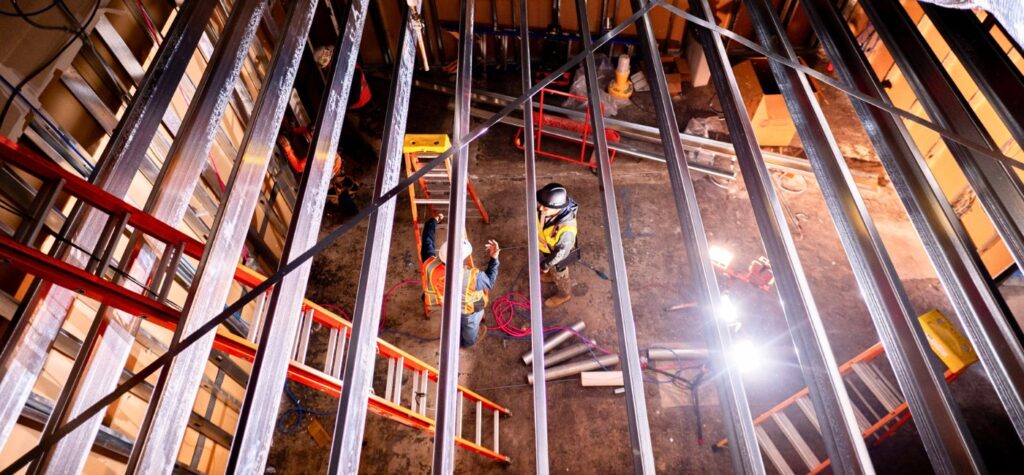
Tenant improvement projects in Orange County’s existing commercial stock carry risks that are better identified before design is finalized. Older buildings in Santa Ana, Anaheim, and Garden Grove regularly surface unreinforced masonry, building systems that don’t match available drawings, and prior tenant work that doesn’t comply with current code. Each represents a condition that becomes more expensive to address the later it’s discovered.
Landlord approval and city permit review run on separate timelines that must be coordinated with construction start. Treating them as sequential steps adds months to preconstruction that aren’t budgeted. WakeCo structures tenant improvement projects to align landlord approval, permit issuance, and construction start on coordinated timelines, reducing the preconstruction drag that catches unprepared projects.
Planning Your Orange County Commercial Construction Project
The patterns that produce cost and schedule overruns on Orange County commercial projects are consistent. Jurisdictional permit gaps, code compliance oversights, deferred subcontractor procurement, and unidentified existing conditions each follow sequences that preconstruction planning interrupts before they become construction-phase expenses.
Business owners who engage a construction manager before lease execution or site control confirm project feasibility at the anticipated budget and schedule while those decisions are still open. Those who engage after absorb costs that earlier involvement would have prevented.
WakeCo brings the construction management experience and Orange County market knowledge these projects require. Contact us to discuss your project and how our preconstruction process addresses the conditions that drive cost and schedule outcomes.
Frequently Asked Questions
How does commercial permitting work across Orange County’s cities?
Orange County’s 34 cities each administer commercial building permits independently, with distinct application portals, fee schedules, and review timelines. Plan check for commercial submittals runs 30 to 90 days depending on the city and how complete the submittal is at the time of application. Identifying the correct jurisdiction and its local amendments before submitting is the most controllable factor in permit timeline management.
What does the 2025 California Building Standards Code change for commercial projects?
The 2025 California Building Standards Code applies to all commercial permit applications submitted on or after that date. The 2025 cycle introduced updated Title 24 energy compliance requirements, revised CALGreen standards, and changes to high-rise classification thresholds that affect fire protection and structural requirements. Design documents prepared against the 2022 code that were submitted after January 1, 2026 require revision before permits are issued.
What types of commercial construction does WakeCo handle in Orange County?
WakeCo provides construction management and general contracting services across ground-up commercial construction, tenant improvements, office build-outs, and industrial facilities throughout Orange County. The firm also serves the public works and land development sectors. Preconstruction services include permit coordination, cost analysis, site evaluation, and subcontractor procurement.
When should a business owner engage a construction manager for an Orange County project?
Before lease execution or site control when possible, and no later than immediately after. Preconstruction evaluation confirms whether a space or site can support the intended use at the anticipated budget and schedule. Permit complexity, existing condition risks, and subcontractor availability in Orange County’s active construction market are each better addressed during preconstruction than after construction has started.
How does Orange County’s active construction market affect commercial project timelines?
Orange County’s industrial construction pipeline reached 2.4 million square feet under construction as of Q2 2025. Subcontractor availability in an active market affects both cost and schedule. Trades committed to large industrial or mixed-use projects have reduced capacity for smaller commercial work, and procurement planning during preconstruction is the most effective tool for securing trade availability before the construction schedule requires it.