Commercial construction in San Diego operates in one of Southern California’s most active and regulatory-layered markets. The city’s Development Services Department administers permits under the 2025 California Building Standards Code with local amendments that took effect April 22, 2026. An active construction pipeline across life science, industrial, and infrastructure keeps trade schedules consistently full.
WakeCo provides commercial construction services throughout San Diego across ground-up construction, tenant improvements, office build-outs, and industrial facilities. Our preconstruction process addresses permit coordination, California code compliance, and subcontractor procurement before commitments are made. Contact us to discuss your project.
San Diego’s Permitting Process
The City of San Diego Development Services Department administers commercial building permits under the 2025 California Building Standards Code, with local amendments effective April 22, 2026. Standard commercial plan check runs approximately six weeks from a complete submittal. About half of all projects require more than two correction cycles, and each cycle adds another full review period to the timeline.
Projects within the Coastal Overlay Zone carry additional review requirements that extend permitting by two to six months beyond standard commercial plan check. Submittals with incomplete documentation extend review regardless of project type or expedited designation. WakeCo prepares permit submittals that address San Diego’s specific application requirements, local code amendments, and completeness standards before applications are filed.
The 2025 California Building Standards Code in San Diego
The 2025 California Building Standards Code took effect statewide on January 1, 2026, and the City of San Diego adopted local amendments on April 22, 2026. Every commercial permit application submitted on or after those dates must comply with the current cycle’s Title 24 energy provisions, updated CALGreen requirements, and locally amended standards.
Design documents prepared against the 2022 code and submitted after the applicable effective date require revision before permits are issued. WakeCo coordinates Title 24 and CALGreen compliance during the design phase, confirming construction documents meet the current cycle before submittals are filed.
San Diego’s Construction Market and Subcontractor Availability
San Diego’s construction market carries one of the most active pipelines in the country. San Diego ranked fifth nationally for office space under construction with approximately 1.68 million square feet underway, driven largely by life science and biotech development in Sorrento Mesa, University Town Center, and Downtown.
The $3.8 billion Terminal 1 rebuild at San Diego International Airport is the largest construction project in the county’s history, with Phase 1B underway in 2026 and eight additional gates expected through 2028. Projects at that scale absorb trade capacity across the region. Procurement planning during preconstruction identifies which trades have capacity for a project’s schedule before commitments are made.
Industrial Construction in San Diego
Otay Mesa is San Diego’s most active industrial submarket, with over 2.1 million square feet under construction across Otay Mesa and Carlsbad as of Q3 2025. The submarket’s border position drives demand from cross-border logistics operators, 3PL users, and manufacturers supporting operations in Tijuana.
The Otay Mesa East Port of Entry, a new federally funded commercial freight crossing, is slated for completion in 2026 and is expected to increase cross-border throughput materially. Industrial buildings in the 100,000 to 250,000 square foot range, the dominant size class in the submarket, carry clear height, dock loading, and trailer parking specifications that differ from general commercial construction.
WakeCo coordinates site evaluation, permit strategy, and subcontractor procurement for industrial projects during preconstruction. Geotechnical findings are confirmed before foundation design is finalized, keeping site-specific risks off the construction phase.
Hospitality Construction in San Diego
San Diego’s hotel market finished 2025 at 72.3% occupancy, among the strongest in California, supported by convention business, leisure demand, and corporate travel from life science and defense sectors. Lodging Econometrics reports 52 hotels with 9,827 guestrooms in the pipeline across the county.
The most active project is J Street’s $250 million conversion of the 25-story Tower 180 office building in Downtown San Diego into a 560-key dual-branded Hyatt, with construction starting in early 2026 and completion targeted for 2028. Hospitality construction involves food and beverage buildouts, rooftop amenity spaces, and guest room fit-outs that each require trade sequencing beyond standard commercial work.
WakeCo manages hospitality projects with the same preconstruction rigor applied to commercial and industrial work, addressing permit coordination, existing condition review, and subcontractor procurement before construction begins.
Tenant Improvements and Office Build-Outs
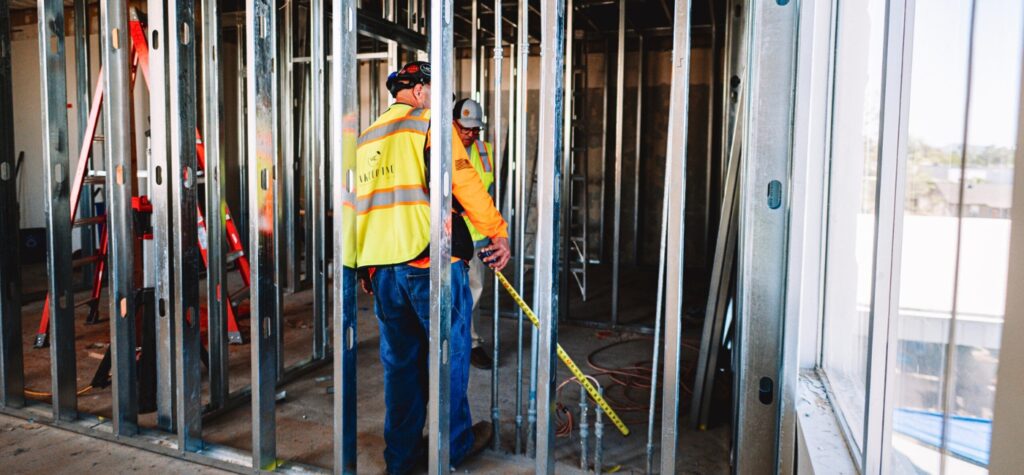
Tenant improvement projects in San Diego’s existing commercial stock surface conditions that are less expensive to identify before design is finalized. Older buildings in Mission Valley, Kearny Mesa, and Downtown regularly carry unreinforced structural elements, building systems that don’t match available drawings, and prior tenant work that doesn’t meet current code.
Landlord approval and city permit review run on separate timelines that must be coordinated with construction start. Treating them as sequential steps adds months to preconstruction that weren’t budgeted. WakeCo structures tenant improvement projects to align landlord approval, permit issuance, and construction start on coordinated timelines.
Planning Your San Diego Commercial Construction Project
The conditions that produce cost and schedule overruns on San Diego commercial projects follow consistent patterns. Permit timeline gaps, code compliance oversights, deferred subcontractor procurement, and unidentified existing conditions each become more expensive the later they’re addressed.
Business owners who engage a construction manager before lease execution or site control confirm project feasibility at the anticipated budget and schedule while those decisions remain open. Those who engage later absorb costs that earlier involvement would have prevented.
WakeCo brings the construction management experience and San Diego market knowledge these projects require. Contact us to discuss your project and how our preconstruction process addresses the conditions that drive cost and schedule outcomes.
Frequently Asked Questions
How long does a commercial plan check take in San Diego?
Commercial plan check in San Diego runs approximately six weeks from a complete submittal, with projects requiring discretionary review taking considerably longer. About half of all projects require more than two correction cycles, and each cycle adds a full review period to the timeline. Submitting complete, code-compliant documents is the most effective way to avoid review delays.
What did San Diego’s local amendments to the 2025 California Building Standards Code change?
The City of San Diego adopted local amendments to the 2025 California Building Standards Code effective April 22, 2026. Applications submitted on or after that date must comply with the current cycle’s Title 24 energy provisions, updated CALGreen standards, and locally amended requirements. Design documents prepared against the 2022 code submitted after the effective date require revision before permits are issued.
How does San Diego’s active construction market affect commercial project scheduling?
San Diego ranked fifth nationally for office space under construction as of mid-2025, with approximately 1.95 million square feet underway across life science and commercial projects. The Terminal 1 rebuild at San Diego International Airport continues through 2028 and absorbs significant trade capacity across the region. Subcontractor procurement during preconstruction is the most effective tool for securing availability before the construction schedule requires it.
What types of commercial construction does WakeCo handle in San Diego?
WakeCo provides construction management and general contracting across ground-up commercial construction, tenant improvements, office build-outs, and industrial facilities throughout San Diego. The firm also serves the public works and land development sectors. Preconstruction services include permit coordination, cost analysis, site evaluation, value engineering, and subcontractor procurement.
When should a business owner engage a construction manager for a San Diego project?
Before lease execution or site control when possible, and no later than immediately after. Preconstruction evaluation confirms whether a site or space can support the intended use at the anticipated budget and schedule. Permit complexity, existing condition risks, coastal overlay requirements, and subcontractor availability in San Diego’s active market are each better addressed during preconstruction than after construction has started.